BURNED HORIZONS
A gritty, turn-based tactical sandbox set in 2002. No XP grind. No class rails. No buy-your-way skill trees. // 'They said it wasn't our war. So we made it ours.'

Offers
What are keyshops?No offers tracked in EUR yet.
About BURNED HORIZONS
Contact, two hundred meters, tree line. Your team hits the dirt before you finish the thought. This isn't the first firefight your squad's walked into, and it won't be the last one that leaves a mark.
Ukraine, 2002. On paper, you're NAFOSEC's Operational Lead in the theater. On the ground, you're right there in the dust with your team—staging out of a forward bivouac, sorting kit, and making the calls when the shooting starts.
There are no clean breaks when the firing stops. You manage contractors who carry the physical and psychological weight of every engagement into the next. Wounds degrade capability, trauma shapes behavior under fire, and casualties require real field extraction. When you commit a squad to an operational area, you live with every call you make—long after the brass stops hitting the dirt.
"It's not just about winning the battle; it's about surviving the war, with all the scars that entails." — Gungho Cowboy, Popular Airsoft
Burned Horizons™ is a turn-based tactical sandbox built on persistent operator health, realistic ballistics, and unscripted squad operations across open sectors.
▬▬▬▬▬▬
// HIGHLIGHTS
SCARS & Flashpoints
Combat leaves more than wounds. Some SCARs build slowly, small marks accumulating over weeks until they finally harden into something lasting. Some form in an instant; one bad moment is all it takes. What comes out the other side isn't guaranteed either. A SCAR might sharpen an operator, break them, or leave barely a trace. One guy might freeze when a room needs clearing. Another might snap and open fire before the stack is set, or carry enough raw anger back to the team that no one trusts him to hold his angle. And when SCARs stack on top of each other, the result isn't predictable: sometimes worse, sometimes not, but never quite what either SCAR would have been alone.
No two operators carry the same war.
UCD/S, Trust & Cohesion
A jacket and a fireteam are the exact same fight. UCD measures your history and standing within NAFOSEC, S-Grade is whether other operators trust you to execute, and Cohesion (COHD) is your raw capacity for leadership and command; whether you're leading a team or moving solo. None of these exist in a vacuum, and none of them guarantee a damn thing. A bad hit to your S-Grade can cause operators to hesitate on your callouts, introducing friction the second the shooting starts. Strong COHD gives you the tools to try and hold a squad together under fire, but even the best leadership can get overwhelmed if conditions turn bad enough. Your company UCD carries weight, but it won't stop a bad drop from testing the trust on your flank. Every one of these systems bleeds into the others. They create friction, exert pressure, and shift depending on how you react when the plan breaks down.
Wounding
Wounds are modeled after physical trauma and physiological breakdown, not a depleting HP bar. Bullets crush tissue, sever arteries, and break bone, and no amount of waiting behind cover brings that back. A hit to the leg ruins an operator's mobility; a hit to the arm destroys their ability to steady a rifle. Keeping your people alive isn't about waiting out a cooldown. It's about applying tourniquets in the dirt, stabilizing trauma under fire, and calling in CASEVAC before they bleed out.
A hit to the leg changes how an operator moves
A hit to the arm changes how they shoot
"That's a permanent souvenir, a little something to remember the holiday by." — Gungho Cowboy, Popular Airsoft
Real Loadouts, Real Weight
Gear isn't cosmetic, and weight isn't an abstract number. Plates only protect what they cover, chest rigs dictate how fast you pull mags, and heavy rucksacks drain stamina before you ever reach the target. Every weapon is customizable down to real components (slings, mounts, optics, and attachments) that change ergonomics, muzzle rise, and weapon handling. Outfit your people for the exact fight ahead of them, not a fixed kit, because a bad loadout will exhaust a squad faster than enemy fire.
Pathways, Specializations & Core Attributes
Nobody steps off the transport a finished product, and no two guys come out of the wash the same. What an operator brings into the theater (Core Attributes), whether that is a mind for a crisis, a head for triage, or how naturally others hold together on their flank, is just their capacity to learn when things go sideways. Put a designated marksman on point duty for three drops, and he isn't going to magically sharpen his cold-bore shots. He's going to learn how to breach a doorway, because that's the dust he actually swallowed. That time in the dirt, combined with what the old hands pass down between ops, is what carves out an operator's Pathway and builds real Specializations over time. You don't pick what your people become; the war does.
No XP Point-Buying: Operators gain proficiency strictly through field execution, not banked point trees.
Zero Class Locks: Initial roles never limit what an operator can learn or adapt to in the theater.
Regional Deployment Commands (RDCs)
Your operators fight across sprawling, persistent theaters, not isolated missions.
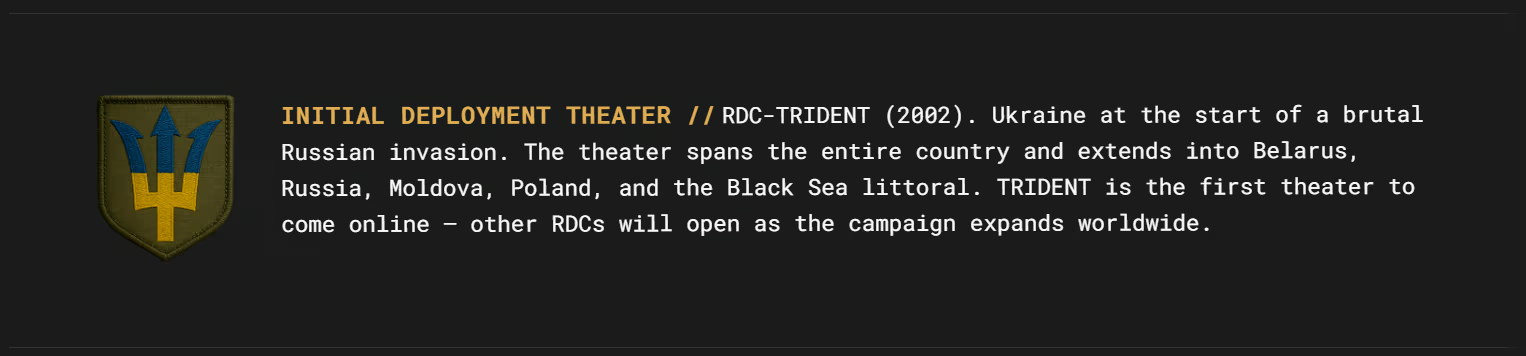
RDC-TRIDENT, 2002: Ukraine, at the start of a brutal Russian invasion
Victories shift front lines
Failures ripple outward
Other theaters open as the campaign expands
Standard Operating Procedures (SOP)
The default reality is cold and unforgiving: no health regeneration, no easy exits, and no second chances. But it's your command. Standard Operating Procedures (SOPs) allow you to tune the operational rules to your preferences. Adjust threat levels, mechanical friction, and campaign persistence from an uncompromising Iron Man baseline to a tailored mandate, without stripping away the tactical foundation of what the game is.
▬▬▬▬▬▬
// FEATURES
Deep tactical combat: action points, suppression, overwatch, interrupts
Realistic wounding system, no health bars, no auto-heal
CASEVAC and reinforcement support called in from the field
Full armor and loadout system: plate carriers, rigs, rucksacks
Deep weapon modding: real components, attachments, and slings
Pathway specializations that grow from what your operators actually do
Squad trust and cohesion that shifts based on shared experience
Switch perspectives: top-down, isometric, or third-person
Fully customizable SOP settings, tune the difficulty and experience to you
Full modding support: sliders, toggles, and beyond
Persistent squads and consequences that carry across the campaign
▬▬▬▬▬▬
// EARLY ACCESS: Q3/Q4 2026 — Targeted exit Q3/Q4 2027
Early Access is where the deeper layers take shape:
Logistics and supply networks, buying, selling, and trading gear
Wider AI behaviors
Strategic movement and maneuver
Advanced operator systems
Vehicles and mobility
Deeper wounding and SCARS integration
Deepening triage and recovery systems
Full mission and operational campaign system
Replacing generic placeholder maps with large, custom-built AOs, progressively expanding to fill out the full RDC-TRIDENT theater
Full persistence framework
Exploring a real-time planning phase, and potentially a plan-and-execute turn-based mode
SPARQ command and team management system
Base building, growing from a patrol base into forward operating infrastructure
Prisoner capture and recruit training
Weather and day/night systems, introduced early and deepened over time
Hunger and survival needs
Realistic tech progression, equipment follows historical timing where it applies, with room for operators to field-test, capture, or improvise gear ahead of its time, as real special operations units have always done
An ongoing authenticity pass, gradually replacing placeholder assets with assets that reflect the period accurately
Continued art passes, replacing placeholder and concept assets with original, final art
Localization for additional languages
Initial set of modding tools
▬▬▬▬▬▬
// BEYOND 1.0
Our roadmap doesn't stop at full release. These are big undertakings in their own right, and anything that isn't as deep as we want it by 1.0 keeps growing from here:
Multiplayer and self-hosted server support
New RDCs (theaters of operation), each a new world tying into the one you already know, bringing new factions, gear, and vehicles with them
Destructible environments, and continued expansion of them even once introduced
Continued deepening of every system, art, weather, fog of war, base building, modding tools, and beyond, wherever EA didn't get us all the way there
HOLD THE LINE. ALWAYS FORWARD.
Game details
Game details
Age ratings
Game modes
Languages
Features
BURNED HORIZONS — frequently asked questions
When does BURNED HORIZONS release?
Steam lists the BURNED HORIZONS release date as Aug 18, 2026.
How much will BURNED HORIZONS cost?
No store has listed a price yet. Set a free price alert on this page and KingsPrice will email you when the first offers appear.
System requirements
Minimum
- OS: Windows 10 (64-bit)
- Processor: Intel Core i5-4430 / AMD FX-6300
- Memory: 16 GB RAM
- Graphics: NVIDIA GeForce GTX 1060 3GB / AMD Radeon RX 480 4GB
- DirectX: Version 12
- Storage: 40 GB available space
- Additional Notes: SSD Recomended
Recommended
- OS: Windows 10 (64-bit)
- Processor: Intel Core i5-6600K / AMD Ryzen 5 1600
- Memory: 16 GB RAM
- Graphics: NVIDIA GeForce GTX 2060 / AMD Radeon RX 5700
- DirectX: Version 12
- Storage: 40 GB available space
- Additional Notes: SSD Recomended